
by Floyd Koontz, WA2WVL first published in QST (ARRL), February 1995 A New Design One fundamental of directive wire-antenna design is that two or more parallel wires carrying similar RF currents produce directivity regardless of the phase or amplitude of the currents, if the wires are separated significantly (greater than […]
Daily Archives: May 14, 2012
12 posts

By Floyd A. Koontz, WA2WVLFirst published in QST (ARRL), January 1996 You’ve seen the basic EWE, now you can have switchable, directional EWEs! Since the introduction of the EWE antenna in QST, many amateurs have improved their low-band receiving capability with a EWE. [1] In the correspondence I’ve received was […]
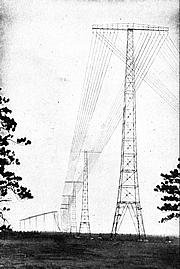
Established theory is timeless, but many amateurs do not have acces to the archives that contain clasical data of present-day interest. Medium frequency DXers should appreciate this update on an historical 1922 QST article. 1 By H. H. Beverage, ex W2BML* and Doug De Maw, W1FB** * silent key January […]
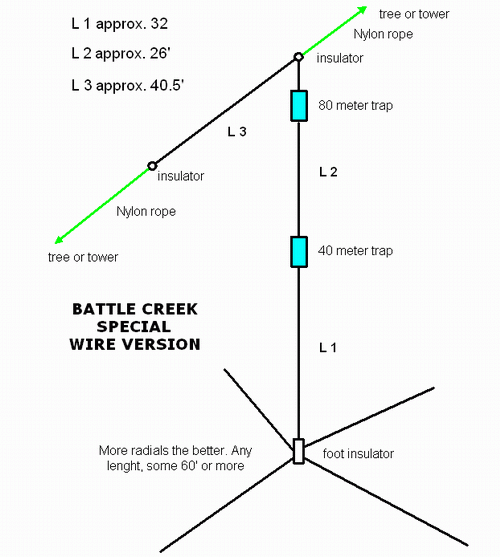
There are 2 versions of the Battle Creek Special shown - a wire version. which will work out first. The traps are made of coax cable as described by W1FB. The second version is a 'real' vertical make of tubes complete with a description of the traps... I hope to unsecret the mystery of the Battle Creek Special and the construction of it.
GENERAL
This antenna is designed for 40, 80 and 160 meters to complement a tri-band beam normally taken on DXpeditions for 10, 15 and 20 meters, so six bands can be worked with only two antennas.

by Earl W. Cunningham, K6SE published in QST (ARRL), Newington, July 2000 These simple, geometrically shaped etheric transducers work well no matter what the geologic characteristics beneath them may be. Invented almost 80 years ago, the Beverage antenna is still the receiving antenna of choice among 160-meter DX enthusiasts. But […]

Mario, S56A, developed many state-of-art SO2R devices. Look at these hi-tech units! S3O2R – S56A Simple Single Op. Two Radio Interface by Marijan Miletic, S56A, N1YU SO2R category is becoming very popular in HF contests. Several PC programs support operation via LPT and COM ports. Commercial switching boxes were recently […]

Why this reprint? You may get some goals here: Download PC boards ready to foil print Download complete data sheet of the relay used Get more construction details This reprint is made under kindly permission of the author, Thomas Moliere, DL7AV [reprinted from the CQ Contest November 1998, p. 8-13] […]

This table, in a slightly different format is found in: Arthur R. von Hippel, ed.: “Dielectric Materials and Applications”, M.I.T. Press, Cambridge, MA, 1954. It was posted on the NEC-LIST, and I foolishly forgot to note the poster’s name, who should be credited The temperature for all tables is 25C. […]
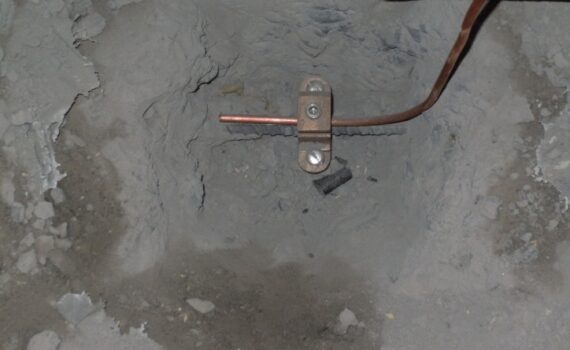
The term “Ufer” grounding is named after a consultant working for the US Army during World War II. The technique Mr. Ufer came up with was necessary because the site needing grounding had no underground water table and little rainfall. The desert site was a series of bomb storage vaults […]
To err is human
That aphorism by an ancient Roman philosopher contains an unexpressed thought: that man, recognizing his error, can correct it, surpass himself, and approach perfection.
And here is another term, circulated by the operators of rare DX stations who reside in exotic locations and by those who spend time and money on DXpeditions and contest operations. It is "European behaviour", this term is used by our friends across the pond and assumes too much. "European behaviour" negatively characterises the conduct of amateurs from more than 50 European nations, so different in origin, culture, language and temperament, that it is difficult to find for them a common denominator. These operators firmly allege that in most every occasion the much-trumpeted amateur spirit of friendship and international co-operation is forgotten, when arises Hamlet's question, To work or not to work a new one?